Producteurs et Commerçants : pour l’approvisionnement des points de vente en produits de la mer, le Groupement Les Mousquetaires a fait le choix de l’indépendance. Armateur majeur français de pêche, Agromousquetaires s’est engagé depuis 2016 pour une pêche et une consommation plus responsable.
Dans un contexte, de changement climatique global et de multiples crises économiques et sociales affectant la pêche française et européenne, le Pôle Mer a procédé à une refonte de son plan « Pêche Durable » élaboré en 2016 afin que sa flotte de pêche et sa filière des produits de la mer continuent de s’inscrire comme une activité nourricière durable au service de la souveraineté alimentaire française.
Cap sur une pêche durable et responsable
Composé de 7 engagements, le plan « Engagés pour une pêche durable » s’inscrit dans une démarche environnementale, sociale et sociétale. L’objectif est de répondre aux principaux enjeux d’une pêche durable.
Sur le plan environnemental, le Groupement porte une attention particulière aux espèces sensibles et aux pollutions marines générées par ses pratiques, développe des techniques de pêche plus sélectives et réduit son impact climatique.
Sur le volet social, il garantit la sécurité des équipages et met en avant le « Made in France » grâce à son positionnement de Producteurs & Commerçants.
Enfin, en réponse à l’enjeu sociétal, il promeut une offre responsable et diversifiée en collaboration avec MSC, Pavillon France et MisterGood Fish.
La Scapêche, leader français sur la pêche
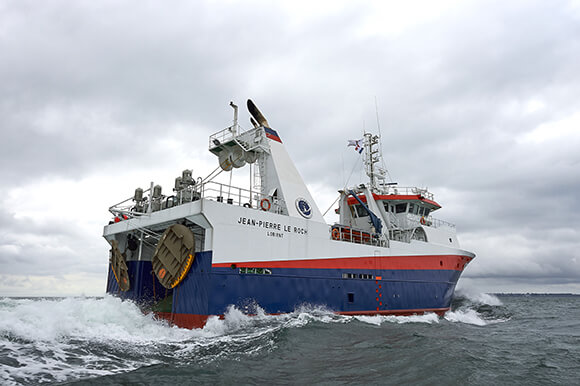
Que de chemin parcouru depuis 1993, année de l’achat d’un premier bateau de pêche ! La Scapêche est un armateur majeur de pêche en France.
Avec la Scapêche, Société Centrale des Armements des Mousquetaires à la pêche, Agromousquetaires contrôle son approvisionnement direct en produits de la mer, sa transformation et sa distribution dans les points de vente Intermarché et Netto.
La Scapêche, c’est 200 marins et 40 personnes à terre pour assurer les fonctions support, une flotte de 15 navires et 13 000 tonnes de poissons débarquées en 2022.
Basée à Lorient, présente en Bretagne, mais également en Écosse, en Irlande et à La Réunion, la Scapêche navigue sous pavillon français dans les eaux françaises et européennes pour alimenter les points de vente en poisson frais, dans le cadre d’une démarche responsable.
Les artisans-pêcheurs, partenaires des Mousquetaires
La filière Pêche d’Agromousquetaires joue un rôle moteur dans le maintien et le développement de la pêche française. Pour ce faire, la Scapêche soutient les artisans-pêcheurs, via des partenariats et la prise de participations dans des entreprises locales.
Dans la région de Boulogne-sur-Mer, la Scopale est une nouvelle forme de construction navale coopérative, en l’occurrence entre la Scapêche, la coopérative maritime Pêcheurs d’Opale et l’armateur boulonnais Groupe Le Garrec.
Dans la région Lorientaise s’est également construit un partenariat sur le modèle de la Scopale, entre la Scapêche et la Scapak avec leurs deux navires Naoned et Dolmen.
Les bateaux construits dans le cadre de ce partenariat permettent un accès à la ressource locale à travers une pêche côtière et saisonnière. Les bateaux comme le « Rose de Cascia » et le « Marmouset 3 » sont équipés pour pêcher les espèces variées qui sont ensuite proposées sur les étals des enseignes Intermarché et Netto.
Ce modèle unique de copropriété répond à une double exigence : la pérennité de la pêche française et la possibilité offerte aux patrons pêcheurs de se lancer dans la construction de navires. En outre, ces derniers ont la garantie des débouchés. Un partenariat gagnant-gagnant !
Capitaine Houat : l’expert de la transformation
Capitaine Houat joue un rôle fondamental dans la filière Pêche des Mousquetaires. Avec 40 000 tonnes de poissons, coquillages et crustacés transformées chaque année, c’est aussi le premier mareyeur français.
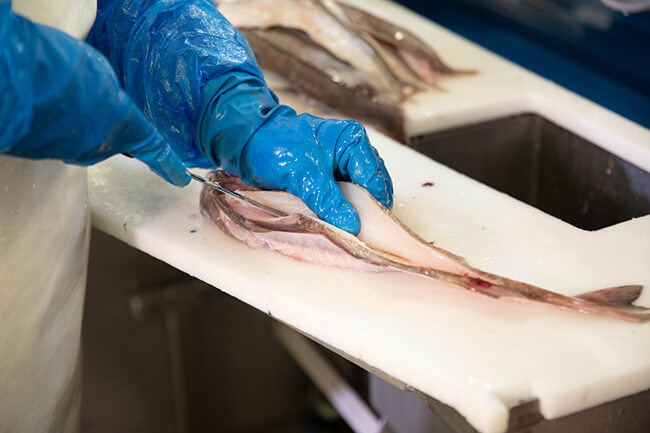
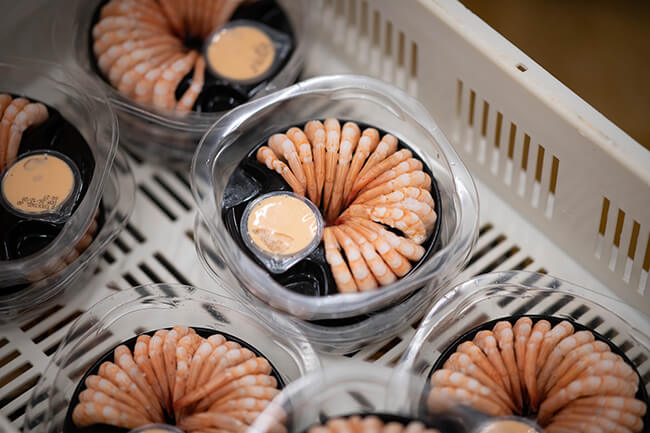
Unité chargée du filetage, du conditionnement et de la transformation d’une partie des poissons de la Scapêche, Capitaine Houat emploie 700 salariés dont 550 sur deux sites. Le premier a été ouvert en 1988 à Lorient Lanester avec l’acquisition d’un atelier de mareyage. Reconstruit en 2012 à Lanester après un incendie, il s’étend sur une surface de 18 000 m² , est certifié IFS, Label Rouge, Produit en Bretagne, ASC, MSC, Crevette filière RSE, Mr Goodfish…et abrite 15 lignes de production où 320 salariés y sont employés. C’est ici que sont produits les filets de poissons blancs, crevettes, coquillages, crustacés, viviers et autres produits libre-service des marques Intermarché.
Le second site se situe à Boulogne-sur-Mer. Il a ouvert ses portes en 1997, et a déménagé sur le site actuel en 2010. Il est certifié IFS, ASC (saumon), MSC (blanc), Pavillon France, Mr Goodfish et Bio, 230 salariés y sont employés sur un espace de 7 000 m². Ses 6 lignes de production assurent la fabrication de filets de poissons blancs, de filets et pavés de saumon et de produits libre-service pour les enseignes du Groupement Les Mousquetaires. Le site de Boulogne-sur-Mer accueille actuellement la Base Mer de Boulogne (télévente et préparation de commandes).
Capitaine Houat ZA Aqualique – 4 place Léon Calon – 62200 Boulogne-sur-Mer 315 rue Germaine Tillon – 56600 Lanester
Les Bases Mer au service des points de vente
Pour la commercialisation et la distribution des produits de la mer, le Groupement s’appuie sur les Bases Mer fortes de 4 bases logistiques à Boulogne-sur-Mer, Bègles, Frontignan et Lorient. Leur mission est d’acheter près de 250 références pour le rayon traditionnel et 100 références pour le rayon libre-service, que propose Capitaine Houat pour approvisionner quotidiennement les points de vente Intermarché et Netto en France.
Ces bases assurent la commercialisation et la distribution des produits de la mer. Elles traitent en tout près de 40 000 tonnes de produits de la mer par an. Elles réalisent, côté logistique, la réception et le contrôle des produits, afin de s’assurer du respect de la réglementation et des cahiers des charges, la préparations des commandes et l’expédition vers les points de vente tout en veillant à la traçabilité.
Côté commercial, les Bases Mer assurent l’approvisionnement des produits, et conseillent au quotidien les points de vente grâce à leur équipe télévente.
Les Bases Mer 315 rue Germaine Tillon – 56600 Lanester
Les consommateurs sont de la partie
La défense d’une pêche responsable et durable se joue aussi sur les étals de nos rayons poissonnerie : les consommateurs doivent apprendre à connaître et à privilégier les espèces non menacées.
La Scapêche capture une diversité d’espèces, parfois méconnues des consommateurs. Cette offre diversifiée permet de proposer des alternatives aux produits les plus plébiscités.
Dans cette optique, 3 types d’outils complémentaires permettent de mettre en avant cette offre, le label MSC, la marque Pavillon France et la démarche MrGoodfish.
Les cookies permettent de faciliter votre navigation et la consultation des pages web.
Un fichier cookie permet également d’identifier le terminal que vous utilisez et, dans certains cas, votre identification de manière indirecte.
L’enregistrement d’un cookie sur votre terminal est essentiellement subordonné à votre volonté que vous pouvez exprimer et modifier à tout moment et ce, à travers les choix qui vous sont offerts ; vous pouvez faire ce choix par notre interface d’administration des cookies, et le modifier dans la rubrique "mentions légales" du site.
En cliquant sur "accepter la sélection", seuls les cookies "essentiels" au bon fonctionnement du site seront installés.
Ce site web utilise des cookies pour améliorer votre expérience lorsque vous naviguez sur le site.
Parmi ceux-ci, les cookies classés comme nécessaires sont stockés sur votre navigateur car ils sont essentiels au fonctionnement des fonctionnalités de base du site web. Nous utilisons également des cookies de tiers qui nous aident à analyser et à comprendre comment vous utilisez ce site web. Ces cookies ne seront stockés dans votre navigateur qu'avec votre consentement. Vous avez également la possibilité de refuser ces cookies. Toutefois, la désactivation de certains de ces cookies peut affecter votre expérience de navigation.
Les cookies nécessaires sont absolument indispensables au bon fonctionnement du site web. Ces cookies assurent les fonctionnalités de base et les caractéristiques de sécurité du site web, de manière anonyme.
Cookie
Durée
Description
cookielawinfo-checkbox-advertisement
1 an
Défini par le plugin "GDPR Cookie Consent", ce cookie est utilisé pour enregistrer le consentement de l'utilisateur pour les cookies de la catégorie "Publicité" .
cookielawinfo-checkbox-analytics
1 an
Défini par le plugin "GDPR Cookie Consent", ce cookie est utilisé pour enregistrer le consentement de l'utilisateur pour les cookies de la catégorie "Analytics" .
cookielawinfo-checkbox-functional
1 an
Le cookie est défini par le plugin de consentement aux cookies pour enregistrer le consentement de l'utilisateur pour les cookies de la catégorie "Fonctionnel".
cookielawinfo-checkbox-necessary
1 an
Défini par le plugin GDPR Cookie Consent, ce cookie est utilisé pour enregistrer le consentement de l'utilisateur pour les cookies de la catégorie "Nécessaire".
cookielawinfo-checkbox-others
1 an
Défini par le plugin "GDPR Cookie Consent", ce cookie est utilisé pour stocker le consentement de l'utilisateur pour les cookies de la catégorie "Autres".
cookielawinfo-checkbox-performance
1 an
Défini par le plugin "GDPR Cookie Consent", ce cookie est utilisé pour stocker le consentement de l'utilisateur pour les cookies de la catégorie "Performance".
CookieLawInfoConsent
1 an
Enregistre l'état du bouton par défaut de la catégorie correspondante et l'état du CCPA. Il ne fonctionne qu'en coordination avec le cookie primaire.
PHPSESSID
session
Ce cookie est natif des applications PHP. Le cookie est utilisé pour stocker et identifier l'ID de session unique d'un utilisateur dans le but de gérer la session de l'utilisateur sur le site Web. Le cookie est un cookie de session et est supprimé lorsque toutes les fenêtres du navigateur sont fermées.
viewed_cookie_policy
1 year
Ce cookie est défini par le plugin "GDPR Cookie Consent" pour stocker si l'utilisateur a consenti ou non à l'utilisation de cookies. Il ne stocke pas de données personnelles.
Les cookies fonctionnels permettent d'exécuter certaines fonctionnalités comme le partage du contenu du site web sur des plateformes de médias sociaux, la collecte de commentaires et d'autres fonctionnalités de tiers.
Cookie
Durée
Description
bcookie
1 an
LinkedIn définit ce cookie à partir des boutons de partage LinkedIn et des balises publicitaires pour reconnaître l'ID du navigateur.
bscookie
1 an
LinkedIn définit ce cookie pour mémoriser les actions effectuées sur le site Web.
lang
session
LinkedIn définit ce cookie pour se souvenir du paramètre de langue d'un utilisateur.
li_gc
6 mois
Utilisé par LinkedIn pour stocker le consentement des utilisateurs invités concernant l’utilisation de cookies à des fins non essentielles.
lidc
1 jour
LinkedIn définit le cookie lidc pour faciliter la sélection de son centre de données.
pll_language
1 an
Le cookie pll _language est utilisé par le plugin Polylang pour se souvenir de la langue sélectionnée par l'utilisateur lorsqu'il revient sur le site Web et pour obtenir les informations relatives à la langue lorsqu'elles ne sont pas disponibles d'une autre manière.
UserMatchHistory
1 mois
LinkedIn définit ce cookie pour la synchronisation des identifiants de LinkedIn Ads.
"Analytics" cookies are used to understand how visitors interact with the website. These cookies provide information about visitor metrics, bounce rate, traffic source, etc.
Cookie
Durée
Description
_ga
2 ans
Le cookie _ga, installé par Google Analytics, calcule les données relatives aux visiteurs, aux sessions et aux campagnes et assure également le suivi de l'utilisation du site pour le rapport d'analyse du site. Le cookie stocke les informations de manière anonyme et attribue un numéro généré de manière aléatoire pour reconnaître les visiteurs uniques.
_gat_UA-38406068-1
1 minute
Une variante du cookie _gat défini par Google Analytics et Google Tag Manager pour permettre aux propriétaires de sites Web de suivre le comportement des visiteurs et de mesurer les performances du site. L'élément de motif du nom contient le numéro d'identité unique du compte ou du site Web auquel il se rapporte.
_gat_UA-90095946-2
1 minute
Une variante du cookie _gat défini par Google Analytics et Google Tag Manager pour permettre aux propriétaires de sites Web de suivre le comportement des visiteurs et de mesurer les performances du site. L'élément de motif du nom contient le numéro d'identité unique du compte ou du site Web auquel il se rapporte.
_gcl_au
3 mois
Fourni par Google Tag Manager pour évaluer l'efficacité publicitaire des sites web utilisant leurs services.
_gid
1 jour
Installé par Google Analytics, le cookie _gid stocke des informations sur la manière dont les visiteurs utilisent un site Web, tout en créant un rapport analytique des performances du site. Parmi les données collectées figurent le nombre de visiteurs, leur provenance et les pages qu'ils visitent de manière anonyme.
CONSENT
2 ans
YouTube place ce cookie dans les vidéos youtube intégrées et enregistre des données statistiques anonymes.
Les cookies publicitaires sont utilisés pour fournir aux visiteurs des annonces et des campagnes de marketing pertinentes. Ces cookies suivent les visiteurs à travers les sites Web et collectent des informations pour fournir des annonces personnalisées.
Cookie
Durée
Description
_fbp
3 mois
Ce cookie est défini par Facebook pour afficher des publicités lorsque vous êtes soit sur Facebook, soit sur une plateforme numérique alimentée par la publicité Facebook, après avoir visité le site web.
AnalyticsSyncHistory
30 jours
Utilisé pour stocker des données sur le moment où une synchronisation a été effectuée avec le cookie lms_analytics
fr
3 mois
Facebook définit ce cookie pour montrer des publicités pertinentes aux utilisateurs en suivant leur comportement sur le web, sur les sites qui ont un pixel Facebook ou un plugin social Facebook.
ln_or
1 jour
Cookie déposé par LinkedIn, non documenté par la plateforme.
test_cookie
15 minutes
Le test_cookie est défini par doubleclick.net et est utilisé pour déterminer si le navigateur de l'utilisateur accepte les cookies.
VISITOR_INFO1_LIVE
6 mois
Un cookie défini par YouTube pour mesurer la bande passante qui détermine si l'utilisateur obtient la nouvelle ou l'ancienne interface du lecteur.
YSC
session
Le cookie YSC est défini par Youtube et est utilisé pour suivre les vues des vidéos intégrées dans les pages Youtube.
yt-remote-connected-devices
YouTube définit ce cookie pour stocker les préférences vidéo de l'utilisateur qui utilise une vidéo YouTube intégrée.
yt-remote-device-id
YouTube définit ce cookie pour stocker les préférences vidéo de l'utilisateur qui utilise une vidéo YouTube intégrée.